
It doesn’t take more than an engraving station, an expensive watch, and a sudden power outage to turn precision engineering into costly scrap. Without a power supply, the holding force disappears and what’s Held above comes crashing down. That’s exactly where MagSpring comes into play: a “spring” that isn’t one, creating tension that leads to relaxation.
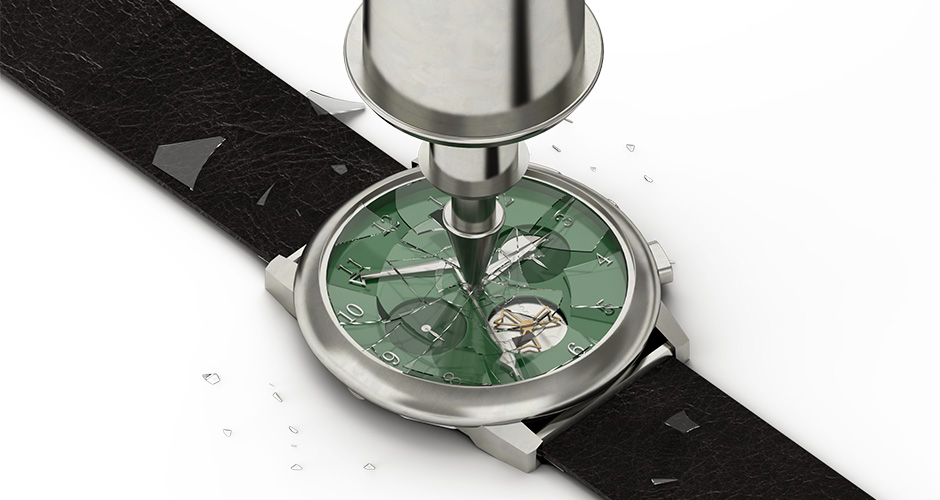
Because MagSpring is more than just a clever component. It provides passive weight compensation, prevents uncontrolled downward motion, and turns system failures into controlled states. No energy supply, no risk — just a simple, robust principle that protects equipment, workpieces, and people.
But how did this idea come to life? And why is it so highly valued across industries today? We spoke with Daniel Ausderau, the “father” of the MagSpring, to learn how a small detail turned into a solution with a wide-reaching impact.
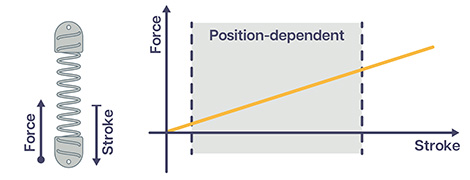
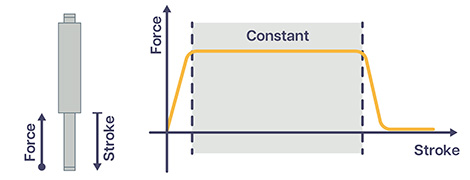
MagSpring is a construction element that, similar to a mechanical spring, generates a defined force over a specific stroke but without any external energy supply. Unlike conventional springs, however, this force remains constant instead of increasing linearly along the stroke.
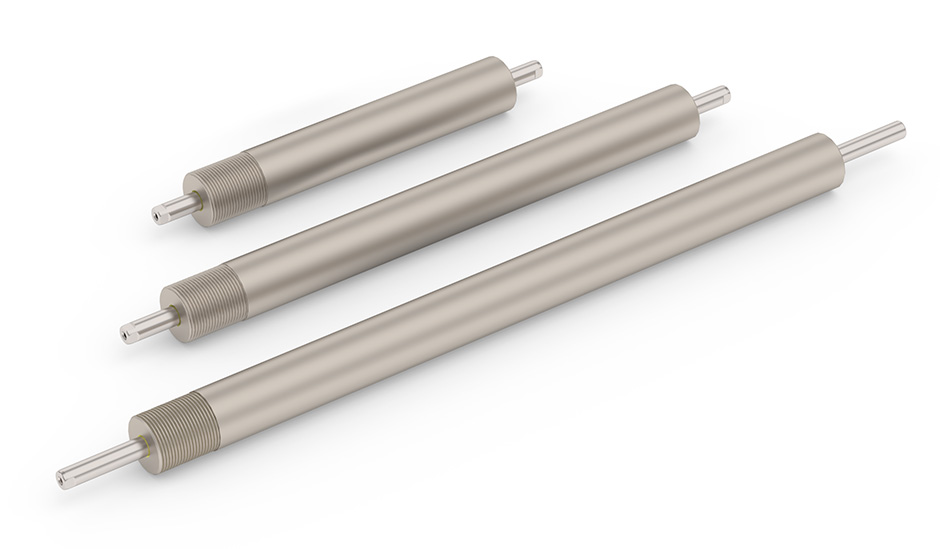
MagSpring consists of a permanently magnetic slider and a magnetizable or permanently magnetic stator. Its magnetic topology is designed in such a way that a constant axial force acts throughout the entire working range. A sliding bearing distributed along the full length of the stator ensures smooth guidance of the slider. The result: a robust, low-maintenance, and long-lasting component.
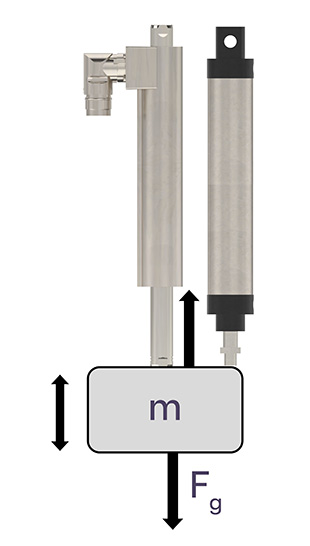
X – Air reservoir with high tightness or aggregate
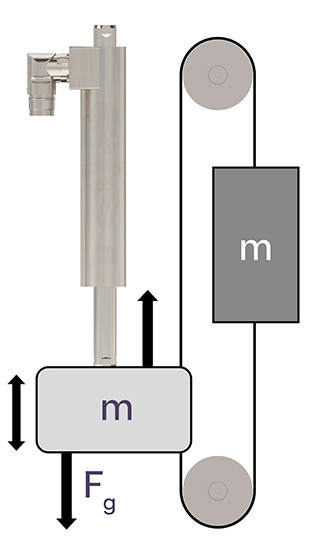
X – Doubling of the moving mass
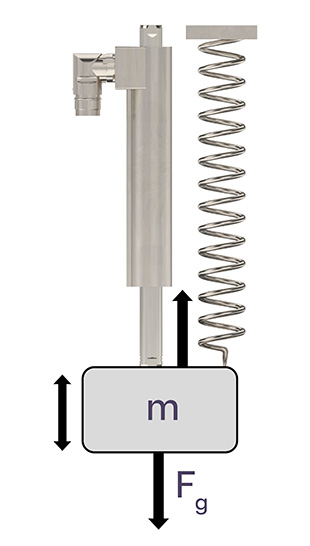
X – Exact compensation only possible at one point
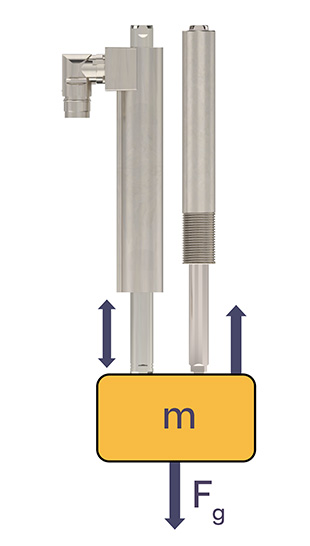
√ – Constant force over the entire stroke
√ – Requires neither electricity nor compressed air
√ – Low moving mass
√ – Highly dynamic without elasticity
MagSpring is the perfect complement to vertically operated linear motors. Working entirely passively and without any external energy, it compensates for the weight force across the entire stroke. This relieves the linear motor, reducing heat generation and freeing up performance reserves for even faster movements. At the same time, MagSpring Acts as a built-in safety element: in the event of a power failure or motor shutdown, it prevents the load from dropping uncontrollably.

is the driving force behind MagSpring. To explore its feasibility, a student Research project was launched at the Department of Information Technology and Electrical Engineering at ETH Zurich. As an assistant at the university, he initiated and supervised the work — with results that laid the foundation for a remarkable success story. Today, MagSprings are firmly established and widely used around the world.
Did you know…
… that compressed air is one of the most expensive Energy sources in production? MagSpring, on the other hand, Needs neither air nor electricity.
MagSpring stands out with its compact design, space-saving integration, and direct connection — with no need for pulleys, flexible belts, or cables. It increases the moving mass by less than 10 %, while a conventional counterweight can easily double it. Thanks to the minimal added mass and the rigid, backlash-free coupling (without elastic elements), MagSpring ensures excellent controllability and dynamics when combined with a linear motor.
Did you know…
… that, unlike a mechanical spring, MagSpring maintains a constant force over the entire stroke?
A mechanical spring with a linear force–displacement characteristic compensates gravity perfectly only at one specific point and tends to oscillate during dynamic operation. Pneumatic systems, on the other hand, rely on compressed air. Their seals require regular maintenance and result in a significantly shorter lifetime compared to MagSpring.
MagSprings are used in combination with vertically operated linear motors across all industries and applications. They are found in single-axis Systems as well as in Z-axes of multi-axis setups, such as pick-and-place modules and robotic systems.
Did you know…
… that MagSpring is also available in a washdown-compatible stainless-steel version and even integrated into our drives?


You are currently viewing a placeholder content from Yumpu. To access the actual content, click the button below. Please note that doing so will share data with third-party providers.
More Information
