
More than just a formality – vertical slicers for cooked meat products
February 24, 2022
Preview of IFFA 2022: Vertical slicer for cooked meat products – Slicing cooked poultry breast fillets into such thin slices that the natural shape of the high-quality product is preserved was previously not possible using automation. The specialist for poultry meat slicers, Food Technology ThielemannLinMot has now presented a world-first solution for this task. Slim, hygienic stainless steel linear motors from LinMot form the basis for the simple construction, high energy efficiency, and high performance of the vertical slicer.
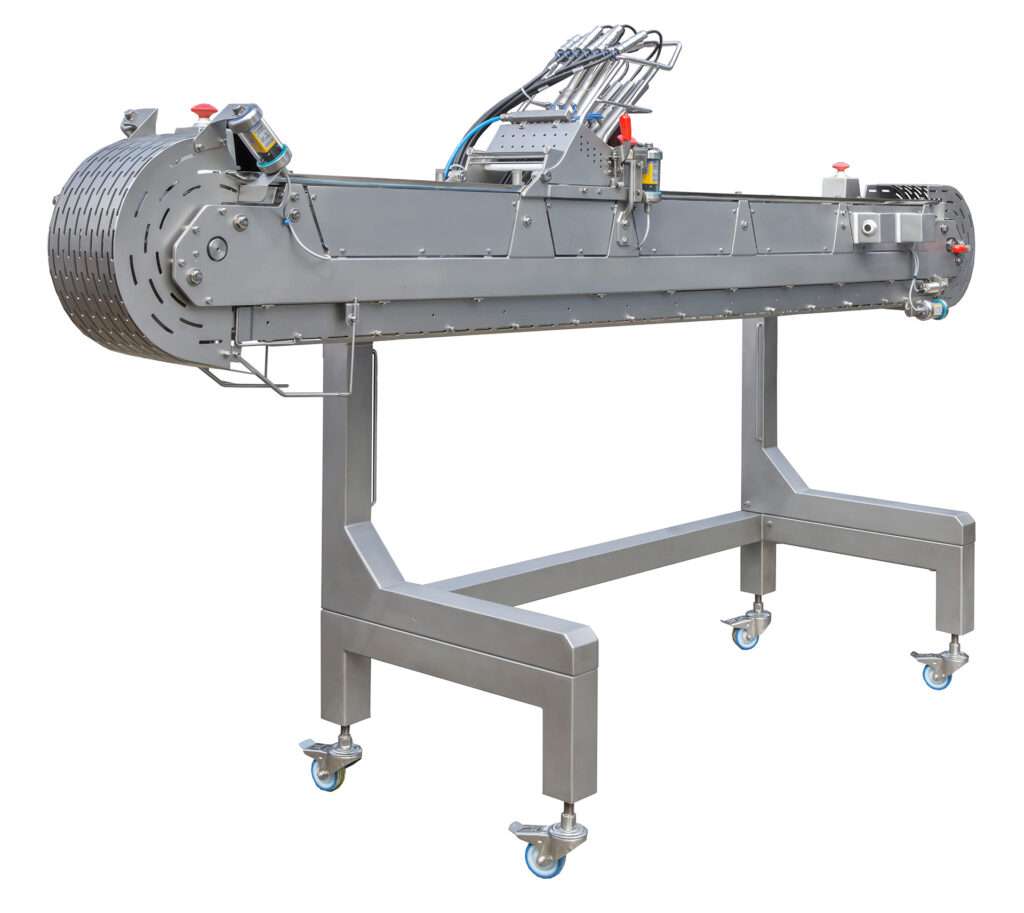
“It’s almost impossible to cut a hard-boiled egg with a simple knife while preserving its shape,” says Ulrich Thielemann, founder of Food Technology Thielemann GmbH & Co. KG. “With an egg slicer, however, it’s no problem.”
The expert in the sales and design of high-performance machines for processing poultry breast fillets drew inspiration from this small kitchen gadget – also known as an egg harp – when developing his latest machine: Just as an egg is placed in the slot of an egg slicer, the chicken breast fillet is positioned in a product carrier with slots for the cutting blades. The meat is then transported on a conveyor chain to the cutting unit. Unlike an egg slicer, however, this machine uses 14 oscillating blades instead of wires to cut the meat. After the fillet is removed from the product carrier, a packaging tray is placed on top, turned over, and fed into a packaging machine for sealing. This process ensures that the natural shape of the poultry breast is preserved, both cut and packaged, until it is ready for consumption.
Overwhelmed: Conventional vertical slicers
“Meat strips for portion packs, like those found in every supermarket, are usually cut with vertical slicers. However, these machines, equipped with circular, sickle, or oscillating blades, are not suitable for the purpose described above,” explains Thielemann. Even with a product carrier featuring a suitable recess for the sliced meat, the task cannot be accomplished, as the meat processing expert clarifies: “It would require 14 parallel blades to produce 10 mm thick slices from an average fillet length of 160 mm. Using circular blades with a thickness of at least 2,5 mm would result in a total displacement of 35 mm. The meat would get stuck between the blades or be torn by them during cutting.”
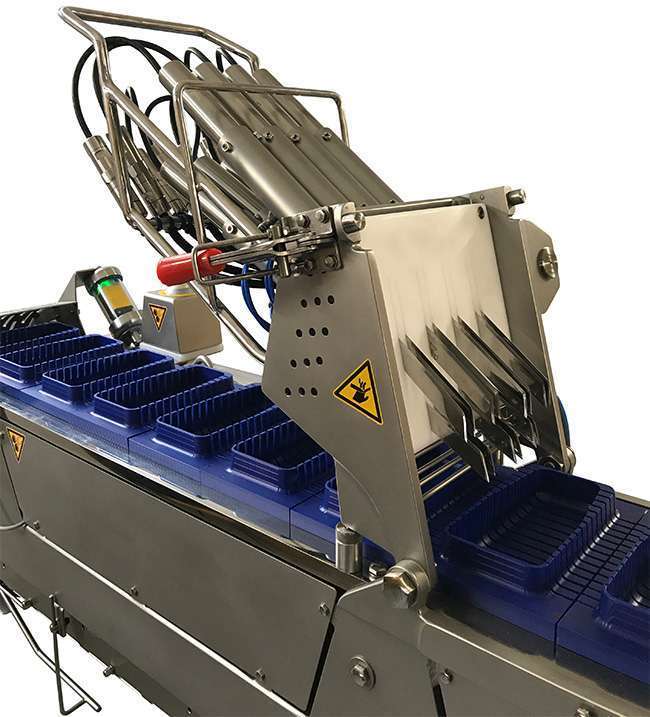
Seven linear motors form the core of the (here folded up) cutting unit (vertical slicer) with 14 blades. (Photo: Thielemann)
Shape and oscillating blades in combination
Thielemann therefore relies on oscillating blades, which perform a cutting motion similar to a jigsaw, also because of the resulting cut quality. The necessary linear motion can be generated in various ways. Traditionally, linear motion in machines with oscillating blades is implemented using rotary motors and eccentric discs or camshafts. "However, we are always striving to further optimize our machines, and this includes the simplest and most robust design possible," Thielemann adds. "I therefore envisioned a drive solution that enables linear motion without a gearbox." For the prototype of the new vertical slicer, the designer had planned to use air motors, but rejected them for the pilot production run due to their disadvantages: "While we were able to implement the required linear motion with these drives, the noise emissions, exceeding 90 dB, and the compressed air consumption of up to 250 liters per minute per blade were simply far too high." The machine manufacturer took notice when LinMot introduced its new SSCP motors in the fall of 2020, specifically designed for use in the food and pharmaceutical industries. They are made of 1.4404 stainless steel (AISI 316L), have an IP69 protection rating, and are equipped with FDA-approved polymer bearings.
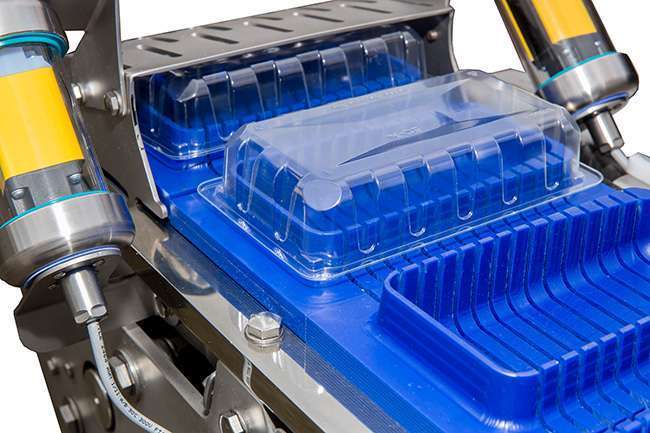
Product carriers with a recess shaped like the product being cut ensure that the product retains its original shape. (Photo: Thielemann)
Simple machine design thanks to slim linear motors
Among the new motors is the PS01-23x160H-HP-SSCP-R20 (stator) variant, which Thielemann chose for the new vertical slicer due to its extremely slim design and high drive force. A total of seven linear motors are arranged in two staggered rows and mounted above the product level: "The small diameter of 28 mm allowed us to position the motors so close together that we can achieve slice widths of 10 mm without any linkage," explains the company founder. There was still enough space to mount the motors with a surrounding metal tube. This was only possible because the motor's rated force of 21,5 N and maximum drive force of 138 N were easily sufficient to mount two blades on each of the high-performance PL01-12×230/190-HP-W01 runners.
The SSCP stainless steel linear motors are not only extremely compact and powerful, but also boast excellent thermal performance. Thielemann therefore manages with simple air cooling for the machine: “Since there is no room for conventional heat sinks, we pump compressed air at 0,5 bar through the installation pipe that partially surrounds the motors. This is sufficient to keep the motor temperature reliably below 60 degrees Celsius during continuous operation at the typical ambient temperatures of around 5 degrees Celsius found in meat processing plants.”
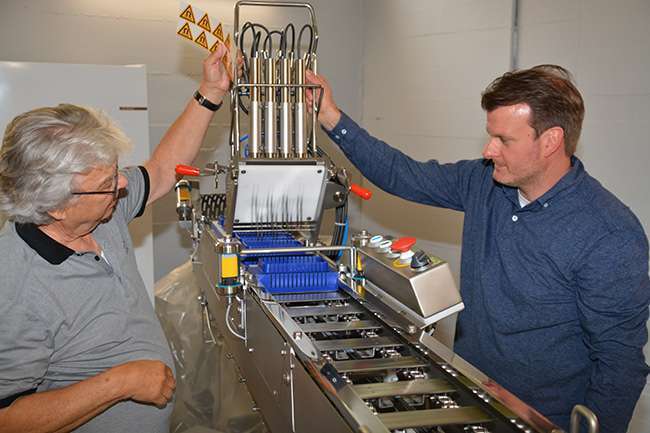
60 fillets per minute
The machine's overall performance is impressive: with 20 cutting strokes of 8 mm per second, it processes 3.600 fillets per hour. "This puts us in the highest performance segment of slicers. The motors could have allowed for even higher cutting speeds, but the handling of the fillets, as well as upstream and downstream processes such as packaging, effectively limit us," Thielemann explains.
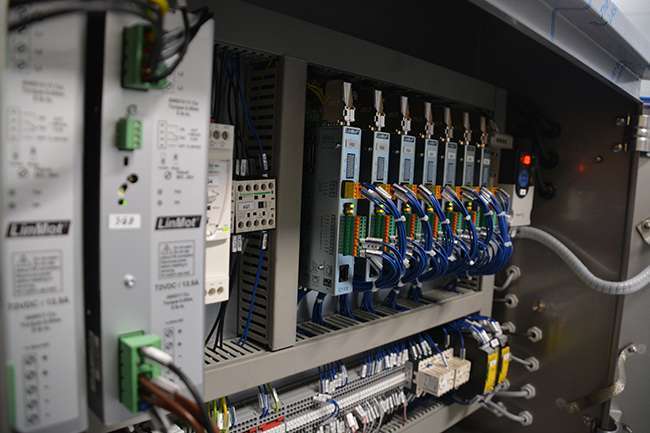
The motors are controlled by seven C1100-GP servo drives with integrated STO (Safe Torque Off) function. A separate control unit with a user interface is not currently planned. LinMot engineers, working closely with Thielemann, handled the drive parameterization. Thielemann praised the quality of the service: "As with a previous project, the support was exemplary, and the collaboration worked exceptionally well, even during the COVID-19 pandemic." This allowed the machine to be planned and built within just a few months. The first user of the machine is a poultry farm in the United Kingdom. The company, which also initiated the development, has thus expanded its range of finished products to include a high-quality, previously unproducible organic convenience product.
This reflects the machine's positioning: slicing cooked goods for ready-made products in the delicatessen sector. Thielemann is convinced that the market potential of the new vertical slicer is correspondingly large: "The possible applications are almost limitless. The trend towards high-quality convenience products continues. This plays right into our hands." The company has therefore placed the machine at the center of its trade fair presentation at IFFA 2022.