
Pick&Place with direct drive technology
25 October 2021
Flexible and lightning-fast: Electric direct drives enable the creation of pick-and-place modules that operate with exceptional efficiency, precision, and dynamics. Furthermore, these modules offer greater flexibility, are more compact, and require less assembly and maintenance than their counterparts with pneumatic or cam drives. The Swiss company PARO AG has made all these advantages easily accessible to itself and its customers with the development of the PARO-Blitz. The machine manufacturer utilizes the pick-and-place system in the construction of assembly lines and special-purpose machines that compete at the highest level in terms of productivity.
“The required standard cycle time for assembly systems has almost halved within a few years and is now approaching one second,” says Gregory Kyd, Technical Director at the Swiss PARO AG“While similarly fast pick-and-place solutions can still be implemented using pneumatics or cam discs, direct drives, as demonstrated by our PARO-Blitz, offer significantly greater efficiency, space savings, and flexibility.” This particularly compact pick-and-place system consists of a horizontally and a vertically arranged linear motor. Depending on the required stroke and dynamics, it can move loads of up to 5 kg and achieve up to 60 cycles per minute. A simple mounting option (dovetail fixing) ensures the quick and precise adaptation of grippers and other handling units. Thanks to fine adjustment at the fixing point and the precision of the linear drives, positions can be reached with a repeatability of +/-0,05 mm. Among the key advantages over pneumatically driven pick-and-place systems is the greater flexibility that the PARO-Blitz owes to its direct drive technology. Since the movements are generated and controlled purely electrically, the machine operator can be provided with functions on the human-machine interface, allowing them to call up and start pre-programmed motion sequences at the touch of a button. This also makes variant production relatively easy. "In contrast, pneumatic cylinders are more or less limited to point-to-point movements; intermediate stops require additional stop screws, and limit switches have to be reconfigured with every stroke change," Gregory Kyd points out.
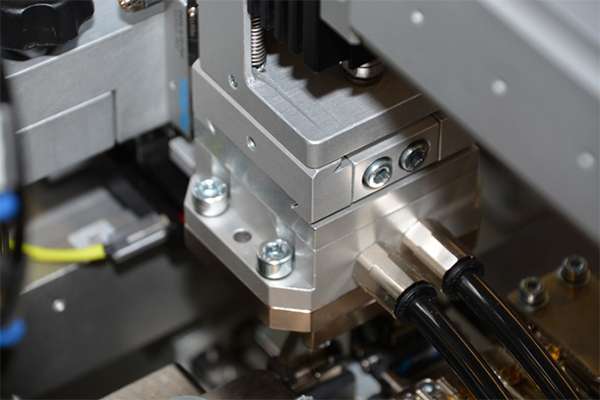
A dovetail joint on the PARO-Blitz allows for easy adaptation of grippers or other handling units. Thanks to fine adjustment and the precision of the linear drives, positions can be reached with a repeatability of +/-0,05 mm. (Photo: Rossmann)
Space-saving, scalable in application
The fact that PARO's engineers were able to design the Blitz to be so compact is largely due to the special-purpose machine and plant manufacturer's decision to use linear motor components from LinMot, explains the company's Technical Director. "When we were surveying the market in the run-up to the PARO Blitz's market launch in 2014, LinMot quickly made it onto our shortlist because of its space-saving design and exemplary construction of its solutions." LinMot ultimately prevailed because of its extensive product range, which includes a wide variety of rotors and stators, as well as complete linear motors with matching controllers and magnetic springs (MagSpring) for weight compensation, and rotary motors. Based on this range, PARO developed several variants of the PARO Blitz for strokes from 50 mm to 190 mm. PARO can therefore use the Pick&Place module frequently in assembly plants, as Gregory Kyd explains: “As of the end of May 2018, more than 200 of the modules are reliably performing their work in over 30 plants.”
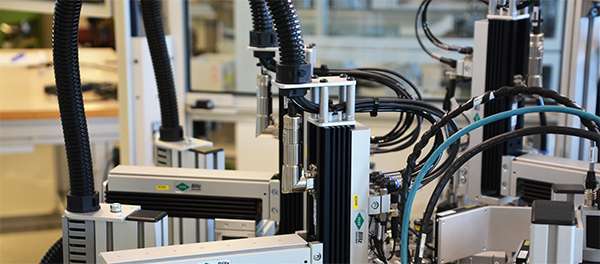
The PARO-Blitz pick-and-place module, developed by PARO AG, is not only highly dynamic thanks to the linear motor components from LinMot, but also particularly compact, making it suitable for integration into systems even where space is limited. (Photo: Rossmann)
Data source for Industry 4.0
If the movement or position of the pneumatic cylinder is to be monitored or used as a guide or control variable, separate sensors must be considered. In contrast, linear motors have an integrated measuring system, allowing the servo controller to provide data such as stroke or force values for each pick-and-place operation. This data can be used, for example, to automatically compensate for temperature-dependent changes in the mechanical components of the pick-and-place system. With pneumatic or cam-based systems, however, the operator must intervene and readjust manually after a machine standstill or in the event of significant fluctuations in ambient temperature. Furthermore, pneumatic cylinders and the air supply or cam discs must be regularly checked for leaks and wear, and end dampers must be replaced regularly. Because a linear motor operates without contact and is therefore maintenance-free, maintenance work on the PARO-Blitz is reduced to a minimum. The guide rails, which are integrated to support the linear movement, also do not require relubrication. The reliability of the Pick&Place module is demonstrated by a demonstrator from PARO AG: As of the end of May 2018, one module had already completed 190 million cycles without maintenance or unplanned interruption. And even if a module eventually needs replacing, this is significantly faster than with a pneumatic system with its numerous compressed air hoses or a cam system with its mechanical couplings. Furthermore, as an electrical module, the Pick&Place can be configured and tested for functionality before installation in the system – resulting in correspondingly short maintenance and repair times. For those responsible at PARO, the significantly higher dynamics of the direct drive technology are almost more important than the high availability of the Pick&Place system, as they contribute to shorter cycle times. "While 60 cycles per minute can be achieved with pneumatic cylinders under certain conditions, this requires considerably more effort." For example, double-acting pneumatic cylinders each require two compressed air connections and possibly a position sensor, whereas a direct drive only needs one electrical cable. This has clear advantages in terms of installation and space requirements, as Kyd explains: "Due to the elimination of the tubing, the PARO flash only takes up about half the space and installation only takes a third of the time compared to the pneumatic counterpart."
More than a pick & place system
Thanks to the advantageous characteristics of the direct-drive pick-and-place system and its compact design, the PARO Blitz's application possibilities extend beyond simple pick-and-place operations. PARO uses it in its assembly systems, for example, for pressing and bending operations, integrated into gantry systems, and as a high-speed infeed system.
In a current system for assembling an electronic module for a building automation application across 31 assembly, processing, and testing stations, the total number of PARO flash units installed is 30. Three linear motor axes are also used for other positioning tasks. Control is achieved via 33 LinMot servo controllers with a Profinet interface. The system comprises three assembly cells, each with a footprint of 2 x 2 meters, linked by the Paromat double-belt transfer system. The most demanding task, which also forms the core process of the system and is performed by a PARO flash unit in the assembly line, is the gripping and positioning of the two connection tabs of a sensor that must be installed on the circuit board of the module. The position of the 0,2-millimeter-thin connecting wires is captured by an image processing system. From this, a three-dimensional movement of the PARO flash unit and the gantry on which it is positioned is calculated individually for each wire and sensor to capture the wires. The wire is gripped, guided to the circuit board, and soldered there. "This simply wouldn't have been possible with pneumatic or cam-driven pick-and-place solutions, as they don't support precise numerical positioning," adds Gregory Kyd. "Furthermore, the required cycle time couldn't be achieved."
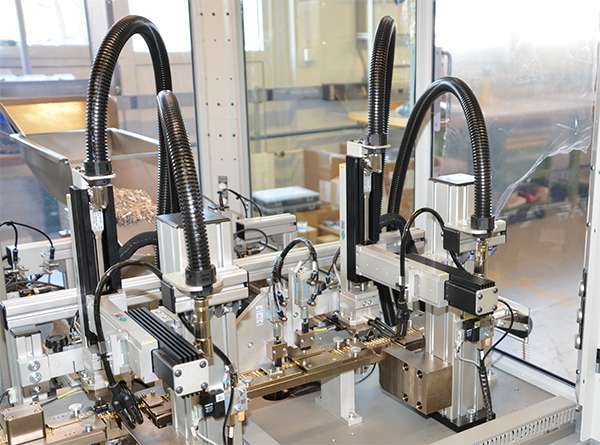
In addition to classic pick-and-place operations, the PARO-Blitz can also be used for pressing or bending processes thanks to the integrated measuring system of the linear motors and the resulting adjustable force application. (Photo: Rossmann)
Linear motors guarantee short cycle times
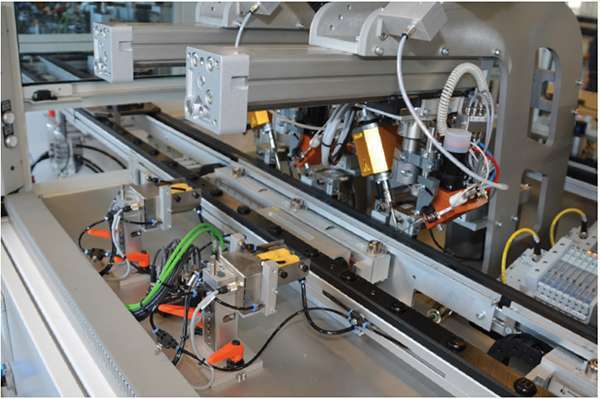
PARO AG also utilizes the PARO-Blitz principle to implement rapid infeed. This allows the workpiece carrier to be pulled from the double-belt conveyor into the processing station or to skip a station in fractions of a millisecond to meet the required cycle time. (Photo: Rossmann)
Other units of the pick-and-place module perform assembly steps such as inserting an LCD display, a rubber contact strip, the circuit board into a housing base, a battery (varies depending on the variant), a security seal, and positioning the components in test stations distributed throughout the system. In addition to these classic pick-and-place operations, the system incorporates rapid workpiece carrier changers based on the PARO Blitz principle. These move the workpiece carrier from the double-belt conveyor into a soldering station or skip a station in fractions of a second, thus extending the available processing time or maintaining the required cycle time. A further linear motor provides the necessary dynamics for stacking and unstacking the fully assembled modules. A MagSpring component compensates for the weight of the vertically mounted axis and ensures a secure position in the event of a machine stoppage. Gregory Kyd is very pleased with the result: “Previously, the customer had to assemble the entire module manually. Now – thanks to the flexibility of the PARO flash unit – there are only two manual steps: attaching an adapter, which varies depending on the end customer and application, and uploading the software. This helps our customer remain competitive even with production in Europe.”