
Linear motors enable innovation in robot grippers
September 19, 2022
By switching from pneumatic cylinders to linear motors, the machine and plant manufacturer Keller HCW has succeeded in developing an innovation in universally applicable robot grippers with high payload capacity, capable of gripping, singulating, and moving even delicate products safely and gently. The electric direct drives are not only responsible for the gripper's high flexibility, but also guarantee repeatability, dynamics, precision, and, last but not least, energy efficiency that cannot be achieved with pneumatic drives.
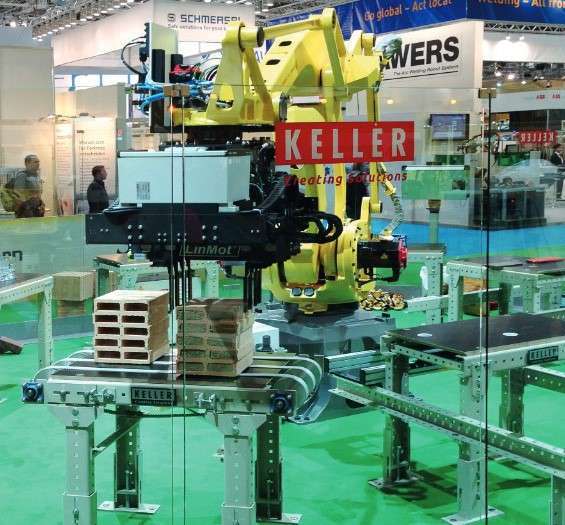
The robot gripper with linear motors developed by Keller HCW is universally applicable and can grip even delicate products safely and gently, grouping them before placement. (Image source: Keller HCW)
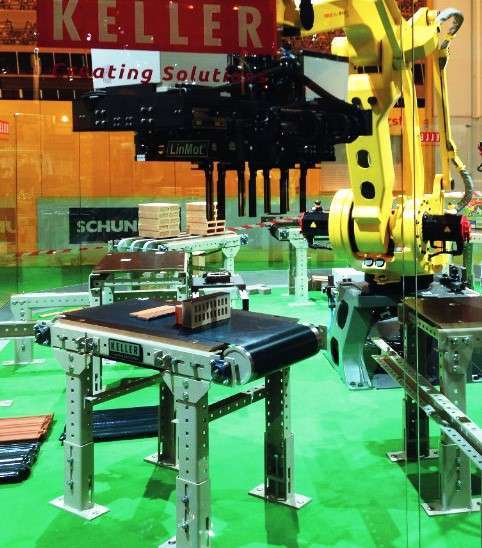
Hollow bricks, drinking glasses, cat food packages, beaver tail tiles, tissue packets, tennis balls – the new robot gripper from Keller HCW handles them all safely and with optimal force. The machinery and plant manufacturer recently demonstrated this with a setup that attracted considerable attention at Automatica in Munich. Keller HCW's robot grippers have proven their worth for years in brickworks and other companies in the heavy ceramics industry. They are used, for example, to grip unfired bricks (molded bricks) and place them at a specific distance to ensure optimal drying and firing. The bricks are fed to the gripper on a continuously running conveyor belt as a consolidated strip of approximately 20 to 30 blanks. The gripper grasps the entire strip, positions the individual bricks at the optimal distance during the robot's movement, and then places them as a group back onto special carriers or conveyor belts. “The challenge lies in the fact that the strength of the molded bricks can vary, meaning we can only operate with a limited gripping force and approach speed. Furthermore, there is only a limited time window in which the bricks must be gripped from the moving feed conveyor,” explains Reinhold Ungruhe, Head of Automation and Electrical Engineering at Keller HCW GmbH. To date, robot grippers with pneumatic drives are predominantly used for singulating the bricks, as well as for other handling processes in the heavy ceramics industry.
Adjustment ranges previously limited to 10 mm by pneumatics
Due to the limited stroke and relatively slow adjustment speed of the pneumatic cylinders, the adjustment ranges must not exceed 10 mm. This is a disadvantage when different tile shapes and sizes are processed on the same line, as is increasingly common. Thus, in developed industrial countries, it is now quite common for the few thousand tiles, including the necessary special tiles (such as verge and ridge tiles), required for a house roof to be produced to customer specifications in a single batch on one line.
In practice, this has meant that brickworks often have to purchase several grippers per robot – usually 6-axis robots – and use them alternately to cover all formats and types. However, with acquisition costs of around €50.000 per gripper, this ties up a significant amount of capital in the companies. Alternatively, users can purchase only one gripper per robot and reconfigure it whenever a change in format or type is required. To minimize these time-consuming reconfigurations for the user, Keller has developed a hybrid gripper in which the pneumatically driven grippers are adjusted using a rotary servo drive, enabling the grouping of more brick formats and types with a single gripper.
Adjusting the pneumatics requires a delicate touch.
“Adjusting the pneumatics is quite tricky in practice,” Reinhold Ungruhe points out. “This is partly because the pneumatic actuators behave differently depending on the ambient temperature, making precise adjustment of the gripping point and force only possible to a limited extent.” Condensation and other contaminants in the compressed air further complicate matters. Pneumatic cylinders are also not maintenance-free: they need to be lubricated, for example. Seals can also become gummed up or leak, especially at high operating frequencies of the drive, requiring the entire cylinder to be replaced.
Keller has therefore gone a step further and developed a fully electrically driven demonstration gripper that is free of these disadvantages. Twelve LinMot PS01-37Sx120-HP-N linear motors move the directly mounted gripping jaws. They are characterized by a maximum stroke of 120 mm, a maximum force of 122 N, and a particularly compact design.
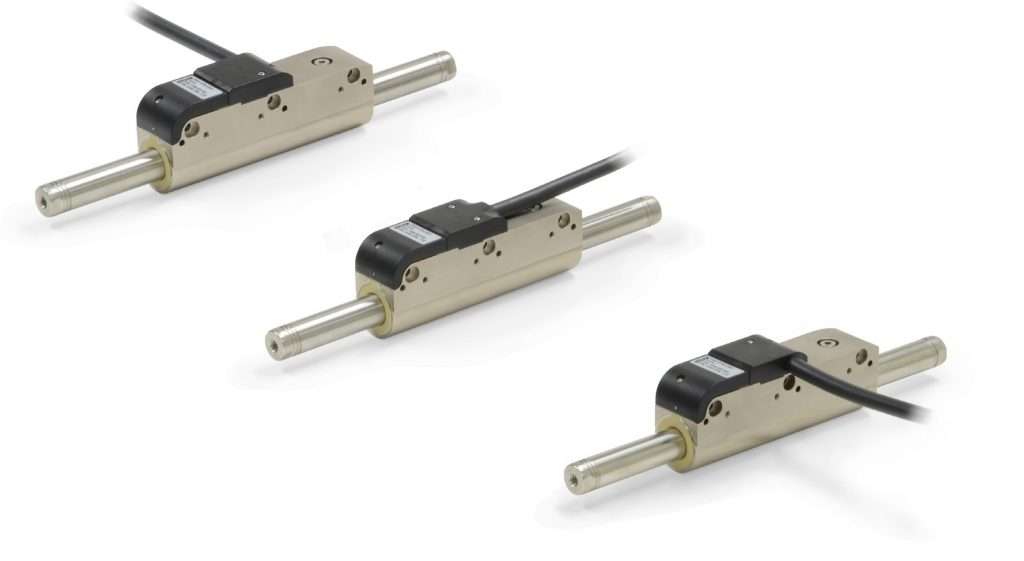
The LinMot PS01-37Sx120-HP-N linear motor from the PS01 series requires little space and is characterized by a large stroke and high maximum force. (Image source: LinMot)
High dynamics and repeatability thanks to linear motors
“Linear motors offer more precise control and are more dynamic than pneumatic drives. They can also handle much larger travel distances in a short time,” summarizes the automation and electrical engineering specialist from Keller. The pattern in which the bricks are placed can be preset via the system's user interface and changed at the touch of a button – without any time-consuming modifications or gripper changes. Unlike pneumatic drives, the gripping force can also be directly controlled. This capability, combined with the large stroke and high dynamics, is largely responsible for the high dynamics and repeatability offered by linear motors, making the gripper so versatile and able to handle delicate products like glass jars or cardboard boxes just as reliably as robust products. The new gripper uses 12 ProfiNet servo controllers from LinMot's C1100 series to control the linear motors. These were specifically designed for applications where pneumatic cylinders are replaced by linear motors. The controllers are very compact and lightweight, measuring just 146 mm in height, 26,6 mm in width, and 106 mm in depth. "This is important with regard to the gripper's payload, as we wanted to place the controllers directly on the gripper to minimize the number of cables running through the robot," explains Reinhold Ungruhe. The disadvantage of the additional weight is generally more than offset by the elimination of previously required valve manifolds, mechanical components, and sensors, as well as the increased flexibility and repeatability of the electric drives. "For series production, the use of LinMot's multi-axis modules or the company's decentralized motors with integrated drive electronics would also be advantageous for further weight and space reduction," adds the automation expert.
Environmentally friendly and economical
In developed countries, another aspect of electric direct drives is coming into focus for users: energy efficiency. "More and more manufacturers of coarse ceramic products are discovering the energy efficiency of their production processes as a differentiating factor and a sales-boosting image factor," reports Reinhold Ungruhe.
Compressed air doesn't fit into this picture, as it is one of the most inefficient and therefore most expensive energy sources. Only about 5% of the energy used is available as usable power in the actuator. Especially with high-speed cylinders, the high noise level alone makes it clear that a great deal of energy is literally wasted. The higher initial costs for an electric drive quickly pay for themselves. Even with conservative calculations, its efficiency of around 97% means it amortizes within a maximum of three years. It's no wonder, then, that more and more companies are striving to completely eliminate compressed air from their production processes. Keller recently implemented a system for stuffing hollow concrete blocks with rock wool entirely without pneumatics. "The great interest that the gripper generated at Automatica in Munich confirms our assessment that many industries beyond the heavy ceramics sector are following this trend and are looking for a flexible and reliable gripping and singulation solution based on linear motors," says Reinhold Ungruhe, looking optimistically to the near future.